Research · June 23, 2026
240,000 plastic particles per liter: what the PNAS bottled-water study actually found.
In January 2024, a team at Columbia University published the first count of nanoplastics — the particles too small for earlier studies to even see — in bottled water. The number was an order of magnitude past what anyone had measured before: about 240,000 plastic particles per liter, roughly 90% of them nanoplastics. Here's exactly what the study did, what the number means, and how to put your own water under a lens.
The headline number
Across the bottled-water samples it analyzed, the study found an average of roughly 240,000 detectable plastic fragments per liter. That is 10 to 100 times more plastic particles than previous bottled-water studies reported — and the gap isn't because the water got dirtier. It's because the older studies could only count the larger pieces.
About 90% of the particles were nanoplastics: smaller than one micron, a size class that simply fell through the cracks of earlier detection methods. The remaining ~10% were conventional microplastics — the only fraction prior research had ever been able to see.
Micro vs. nano — why the distinction matters
Microplastics run from 1 micron up to 5 millimeters. Nanoplastics are below 1 micron — under 1,000 nanometers. The size isn't just bookkeeping: smaller particles are more numerous, harder to filter, and small enough to cross biological barriers that micron-scale particles can't. Counting only microplastics, as researchers did for years, was measuring the visible tip of a much larger distribution.
How they counted what no one could see
The breakthrough was the instrument. Coauthors Wei Min and Naixin Qian used stimulated Raman scattering (SRS) microscopy: two laser beams tuned so that individual particles light up by their own molecular vibration. That lets the system not only spot a sub-micron particle but identify which plastic it is, one particle at a time, automatically.
The water contained all seven common plastic types. The most abundant wasn't the bottle plastic — it was polyamide, a nylon commonly used in the filters that purify water before it's bottled. Close behind was PET (the bottle itself) and polystyrene. In other words, some of the plastic is shed by the packaging, and some is introduced by the purification step that's supposed to clean the water.
What the study does and doesn't say
- The researchers tested three popular U.S. bottled-water brands but did not publicly name them — so this isn't a ranking of specific labels.
- A high particle count is not the same as a proven health dose. The study measured exposure; it did not measure harm. What nanoplastics do inside the body is still being researched.
- The numbers are specific to bottled water in PET. They don't transfer one-to-one to tap or filtered water, which is exactly why testing your own source is worth doing.
- A 2024 follow-up exchange in PNAS debated lab blank controls — normal scientific scrutiny — but the core finding that nanoplastics dominate the count has held up in coverage and follow-on work.
See it in your own water
You can't run an SRS microscope at home — true nanoplastics need a lab. But you can see the microplastic fraction, the same one the older studies counted, with the same Nile Red fluorescent staining chemistry — see our full breakdown of what an in-home test kit can and can't detect for the size-class limits. The in-home microplastics test kit uses separately sold tests: pour a sample, stain it, filter it, and the plastic glows under blue light. Test a fresh bottle against your tap and compare the two — the microplastic test kit for bottled water walks through that pour, bottle by bottle, and the step-by-step testing guide has the full protocol.
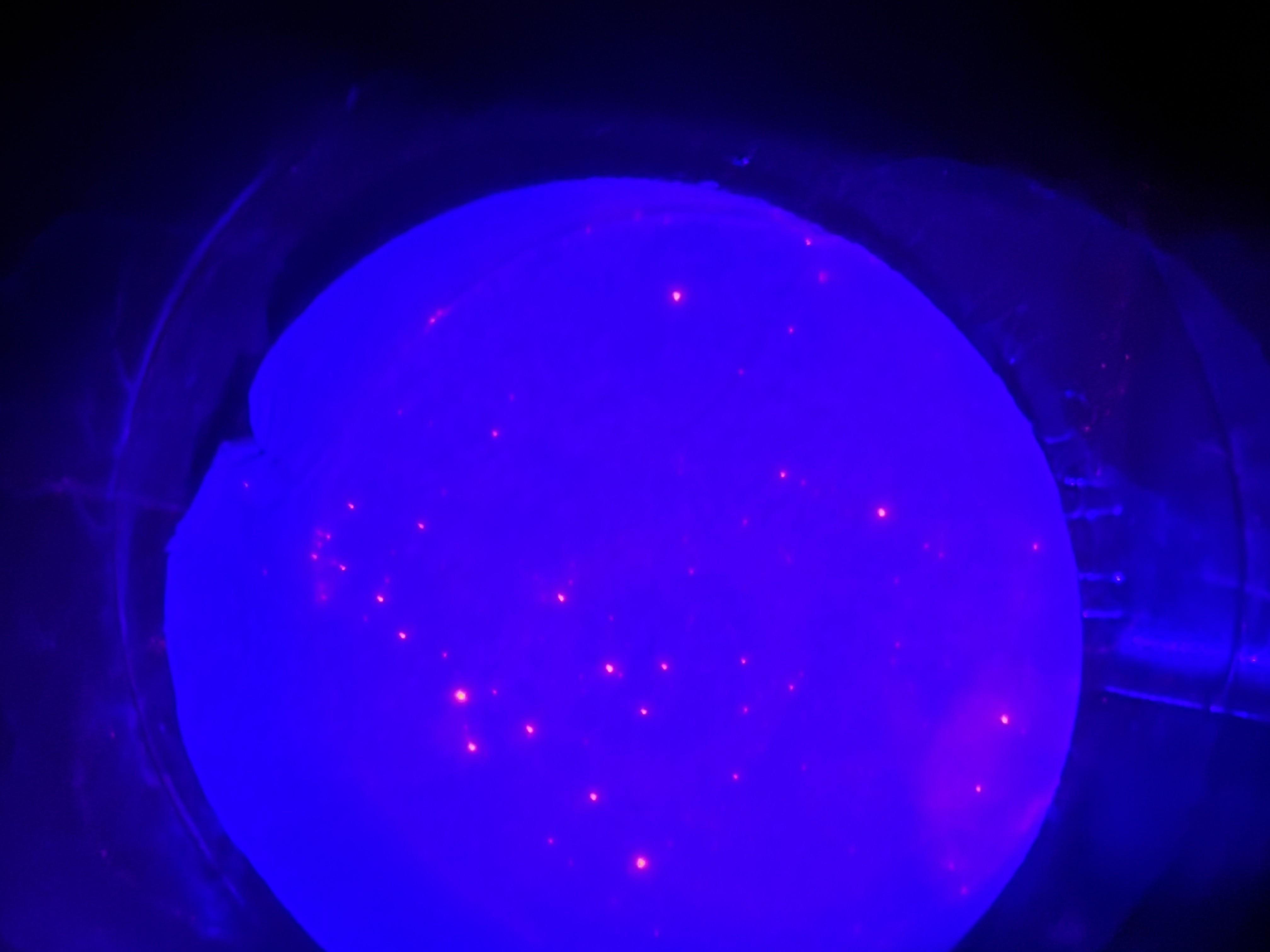
Real customer result from a plastic-bottled water sample — the stained microplastic fraction under blue light.
Want the brand-by-brand picture instead? See what the research shows for Fiji, Smartwater, Dasani, and Poland Spring, or read where these particles end up in the human body.
Common questions
How many plastic particles are in bottled water?
A 2024 PNAS study from Columbia University found an average of about 240,000 plastic particles per liter of bottled water across the brands it tested. Roughly 90% of those were nanoplastics — particles smaller than one micron — which earlier studies could not see or count.
What did the 2024 PNAS nanoplastics-in-bottled-water study find?
Published in PNAS on January 8, 2024, the Columbia University study (Qian et al.) used stimulated Raman scattering microscopy to count plastic particles down to about 100 nanometers — far smaller than older methods could resolve. Across the bottled water it tested, the average came to roughly 240,000 plastic particles per liter, about 90% of them nanoplastics under 1 micron.
What is the difference between microplastics and nanoplastics?
Microplastics are plastic fragments between 1 micron and 5 millimeters. Nanoplastics are smaller than 1 micron (under 1,000 nanometers). The 2024 PNAS study mattered because most prior bottled-water research counted only microplastics; the new method showed nanoplastics outnumber them roughly 9 to 1.
Which plastics were found in bottled water?
The study detected all seven common plastic types. The most abundant was polyamide (a nylon often used in the filters that purify the water before bottling), followed by PET — the plastic the bottles themselves are made of — and polystyrene.
Can you test bottled water for microplastics at home?
An at-home kit using Nile Red fluorescent staining will reveal microplastics (roughly 1 micron and larger) on a filter under blue light. It will not count true nanoplastics — that requires lab instruments like the SRS microscope used in the PNAS study — but it gives a real, visible particle count from your own bottle.
Sources
- Qian, N. et al. “Rapid single-particle chemical imaging of nanoplastics by SRS microscopy.” PNAS, Jan 8 2024. DOI 10.1073/pnas.2300582121
- Columbia Mailman School of Public Health — “Bottled Water Can Contain Hundreds of Thousands of Nanoplastics.”
- National Institutes of Health (NIH Research Matters) — “Plastic particles in bottled water.”
Related