Guide · August 1, 2026
How to test bottled water for microplastics
Pour 100 mL straight from the bottle, stain it with Nile Red, filter it, and look under a microscope. It's the same fluorescent-staining method published bottled-water research uses, packed into a 15-minute kit — and bottled water usually tests dirtier than the tap, because most of the plastic comes off the bottle itself.
The 4 steps
- 1Pour 100 mL from the bottle into a clean glass container. Shaking the capped bottle first is optional — it releases more particles from the cap threads, a real variable worth isolating rather than avoiding.
- 2Add the Nile Red dye vial and wait 15 minutes minimum. Longer is fine, and better. The dye binds to plastic, not minerals.
- 3Push the sample through the syringe filter in one pass. Plastic particles are trapped on the filter face.
- 4Place the filter under the digital microscope and look. Pink dots are plastic particles under Nile Red staining. You read the result yourself, live, in minutes.
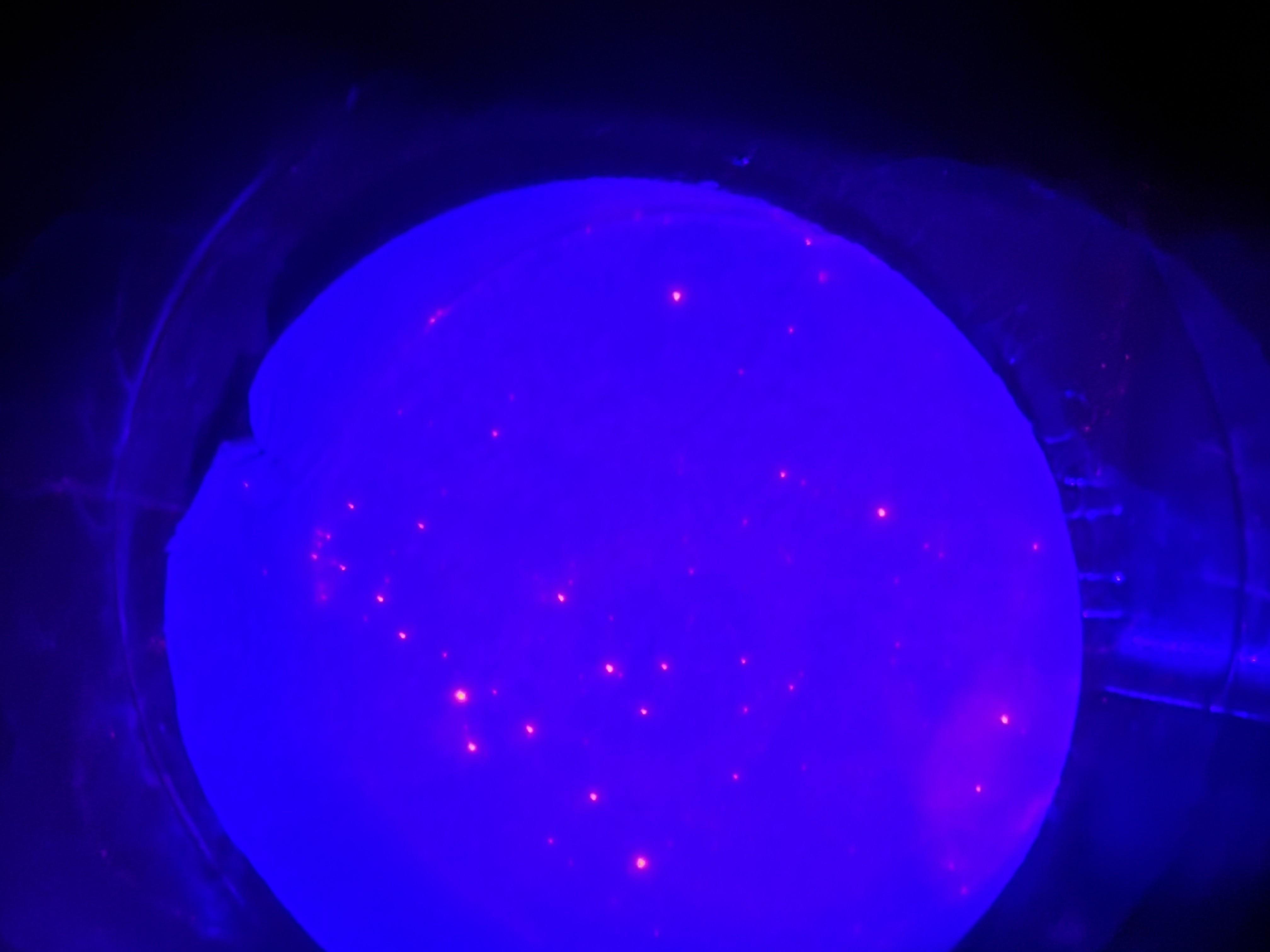
A real result: 100 mL from a SmartWater bottle that sat in a car for one year.
What published research already found
The 2018 Orb Media / SUNY Fredonia study (Mason et al.) tested 259 bottles across 11 global brands and found microplastics in 93% of them, averaging 325 particles per liter — the worst brand tested, Nestlé Pure Life, averaged 930/L. Most of that plastic comes from the PET bottle itself: the cap thread, the wall flex, the heat from trucks and warehouse pallets, not the source water.
A 2024 Columbia/Rutgers PNAS study (Qian et al.) pushed resolution down to ~100 nanometers with stimulated Raman scattering and counted roughly 240,000 plastic particles per liter in three US brands once nanoplastics were included — about 90% of that total smaller than 1 micron, below what any consumer kit can resolve. Read the full breakdown in the PNAS nanoplastics study. An in-home kit counts the microplastic fraction at 1 micron and up — a visible proxy for the larger invisible nano load in the same bottle.
Bottles we've already tested
We run this exact protocol on camera and publish the filter photo, not just a number.
- Dasani: net count of 9 particles, and why the number everyone expects is wrong →
- SmartWater after a year in a hot car — too dense to count →
- Fiji water →
- Aquafina →
- Poland Spring →
Get the kit
The full protocol above runs on the in-home microplastics test kit (tests sold separately). The bottled-water testing page has the product details and pricing; this guide is the step-by-step.
Common questions
How do you test bottled water for microplastics?
Pour 100 mL straight from the bottle into a clean glass container, add a Nile Red dye vial, wait 15 minutes minimum, push the sample through a syringe filter, then look at the filter disc under a digital microscope. Stained plastic particles glow bright pink. It's the same fluorescent-staining method used in published bottled-water research, condensed into an in-home kit.
Can you test bottled water for microplastics at home?
Yes. No lab or mail-in step is required — the Nile Red stain, syringe filter, and digital microscope all ship in the kit, and you read the result yourself, live, in about 15 minutes.
Does bottled water actually have microplastics?
Usually more than tap. The 2018 Orb Media / SUNY Fredonia study (Mason et al.) tested 259 bottles across 11 global brands and found microplastics in 93% of them, averaging 325 particles per liter — the worst brand, Nestlé Pure Life, averaged 930/L. A 2024 Columbia/Rutgers PNAS study (Qian et al.) used stimulated Raman scattering to count roughly 240,000 plastic particles per liter in three US brands once nanoplastics were included.
Do I need a blank before testing bottled water?
Read the filter disc before running your sample so you know its baseline — membranes can carry a stray fiber or two straight from the package. Subtract that baseline from your sample count to get the net particle count, the same way a lab would.
Does shaking the bottle change the result?
It can raise it. Agitating a capped bottle before you pour flexes the cap threads and the bottle wall, which is exactly where PET sheds — so a shaken sample isn't a 'worse' test, it's testing a real-world variable (a bottle that rode in a bag or a hot car). Pour straight and pour shaken as two separate 100 mL samples if you want to isolate the effect.
What's the difference between testing bottled water and tap water?
Same protocol, same kit, same 15 minutes — the only difference is the sample source. Tap tests what's in the pipe; bottled tests the water plus whatever the PET bottle itself has shed. Most people run both and compare the two filter discs side by side.
Related