In-home kit · ~15 minutes
Microplastic test kit for tap water.
The Orb Media survey found microplastics in 94% of US tap samples. Your utility doesn't test for them, so nobody knows the count from your faucet. The microplastics test kit is the in-home version of the same Nile Red protocol the survey used — results you can count with your own eyes in about 15 minutes. Tests are sold separately.
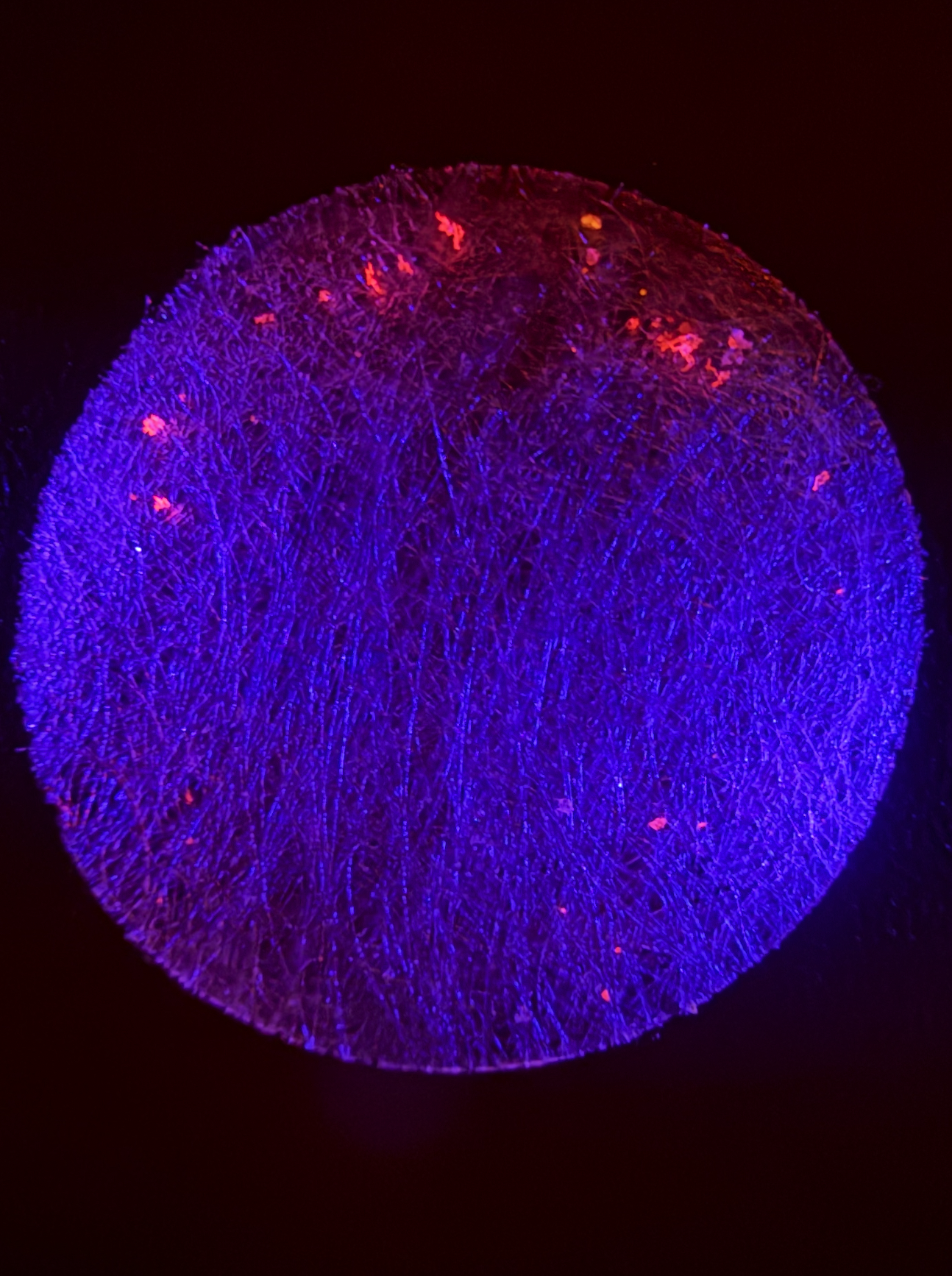
A real tap-water filter from the in-home kit. Pink dots mark particles that took up the Nile Red stain — likely microplastics.
Why test tap water for microplastics at all
Three independent sources put plastic in your tap. Source water (rivers, reservoirs, groundwater) carries atmospheric and runoff-borne microplastics that conventional coagulation and flocculation reduces but does not eliminate. The treatment plant itself uses plastic gaskets, polymer membranes, and polypropylene piping. And the last mile — your home's service line and indoor plumbing — adds particles every year it's in use, especially when the line is PEX, CPVC, or polypropylene.
A 2019 review in Water Research concluded the contribution from plastic distribution piping can equal or exceed the contribution from raw source water in homes with extensive plastic plumbing. If your house was repiped in the last 20 years, the dominant source is almost certainly your own pipes — not the utility.
Your utility doesn't measure any of this. As of 2026 no US water system is required to test for microplastics, the annual Consumer Confidence Report doesn't include them, and California's 2022 monitoring policy (the only one in the country) doesn't surface the data to customers.
The particles you can count are only part of what's there. Every microplastic source also sheds nanoplastics — particles under 1 micron that are too small for any optical method and small enough to cross cell membranes and the blood-brain barrier. The filter captures particles down to 1 micron and the included microscope sees them down to about 5 microns; that visible count is a proxy for the larger invisible nano load. Here's the full breakdown of nanoplastics vs microplastics.
How the kit tests tap water
Same three-step protocol as every sample type. The only thing specific to tap water is the collection — pour 100 mL of cold tap into a clean glass container, ideally the first pour after the line has been sitting overnight.
- 1Collect 100 mL of cold tap water in a glass container. First-pour-of-the-morning gives the highest particle count — that water has been sitting in your home's pipes overnight.
- 2Drop in the Nile Red vial. Swirl. Wait 15 minutes minimum — longer is fine, and better. Dye binds preferentially to plastic; minerals and salts don't take it up, though some organic matter can.
- 3Push the entire sample through the membrane filter. Particles down to 1 µm are trapped on the disc face.
- 4Place the filter under the included digital microscope and look. Particles that took up the stain glow bright pink and are counted as likely microplastics. You read the result yourself, live under the microscope, in minutes.
The four tap-water tests worth running
Cold morning tap. The baseline. Overnight stagnation pulls the most particles off the pipe walls.
Cold flushed tap. Run the cold tap for 2 minutes, then sample. Compare to the morning sample — the difference is plumbing-shed particulate.
Hot tap. Heat accelerates polymer release from any plastic in the path (PEX, dip tubes, water-heater liners). Usually the highest count.
Filter output. Whatever filter you trust — Brita, RO, fridge dispenser — pour its output into the cup. Compare to your cold tap. That delta is the only honest answer to does my filter actually remove microplastics.
FAQ
Can a microplastic test kit detect particles in tap water?
Yes. The kit traps particles down to 1 micron on a 25mm membrane filter and stains them with Nile Red, which fluoresces pink under 450nm blue light. The included digital microscope sees particles down to about 5 µm, and glowing particles are counted as likely microplastics — a screening count, not lab confirmation. The 2017 Orb Media tap-water survey used the same Nile Red methodology and found microplastic particles in 94% of US tap samples; the kit packages that published protocol for a kitchen counter.
Which tap should I test — cold morning, hot, filtered, or kitchen?
Cold tap, first thing in the morning, from the kitchen. That sample has been sitting in your home's pipes overnight and picked up whatever they shed — it's the highest-particle sample you can take. Run the second test on hot tap or on your filter output to compare.
How many milliliters of tap water does one test need?
100 mL — about 3.5 ounces. The kit includes a graduated viewing cup so you don't need a separate measuring tool. Each refill runs one test, so order one for every sample you want to compare.
Does the kit work on well water?
Yes, the chemistry is the same. Well water on average has fewer source-borne particles than surface-fed municipal water, but home plumbing (PEX, PVC, plastic-lined pressure tanks) still adds particles. Test it the same way: cold tap, first pour of the morning.
What about nanoplastics — does the kit count those?
No. Microplastics run 1 micron to 5 mm; nanoplastics are smaller than 1 micron, and below that size particles cross cell membranes, the gut lining, and the blood-brain barrier. Nanoplastics are smaller than any optical method can resolve and need a lab (py-GC/MS, SRS microscopy, electron microscopy). The filter captures particles down to 1 micron, and the included microscope sees them down to about 5 microns. Use that count as a proxy: a high microplastic reading from your tap means a far larger invisible nano load from the same source. See microplastics and nanoplastics for the difference.
What count is 'normal' for tap water?
Published tap-water counts range from low single digits to a few hundred particles per liter, depending on which size class the study counts. Our procedural blank — clean, filtered water run through the full process — consistently returns 0–3 particles on the filter. Anything materially above that is likely microplastic load — the interesting question becomes which sample in your house has the most.
Is testing tap water for microplastics legally meaningful?
Not yet. The EPA added microplastics to Contaminant Candidate List 6 in April 2026, but there is no enforceable Maximum Contaminant Level, no required utility reporting, and no legal definition of 'too much.' The kit gives you a count for your own decision-making — not a regulatory measurement.