Research · April 19, 2026
Can the in-home kit detect microplastics from PEX pipes?
Short version: yes, for particles larger than about 5 µm with the included microscope. PEX is cross-linked polyethylene, and polyethylene is the single brightest polymer under Nile Red fluorescence. A PEX flake on the filter glows pink the same way an LDPE shred does. The nanoplastic fraction slips through the 1 µm filter, which is a limit of every optical method at digital-microscope resolution. The interesting sample is not the cold tap. It is the first draw out of a hot line that has been sitting overnight.
Why polyethylene is the easiest polymer to catch
Nile Red is a hydrophobic dye. It partitions into non-polar surfaces and fluoresces when it gets there. The more hydrophobic the polymer, the stronger the signal. Polyethylene (LDPE, HDPE, and every variant in between) sits at the top of that list. Polypropylene is close behind. Polar polymers like nylon and PET stain weakly and need longer incubation to show up at all.
PEX is polyethylene with extra bonds between the chains. The cross-linking changes how the plastic handles heat and pressure. It does not change the surface chemistry that Nile Red cares about. The dye still sees a PE surface. The particle still fluoresces pink under a 450 nm blue LED and an orange long-pass filter.
Practically: if you shed a visible flake of PEX into a glass of water, stain it, filter it, and look at it under the microscope, you get the same bright pink signal you would get from a shred of LDPE cling film.
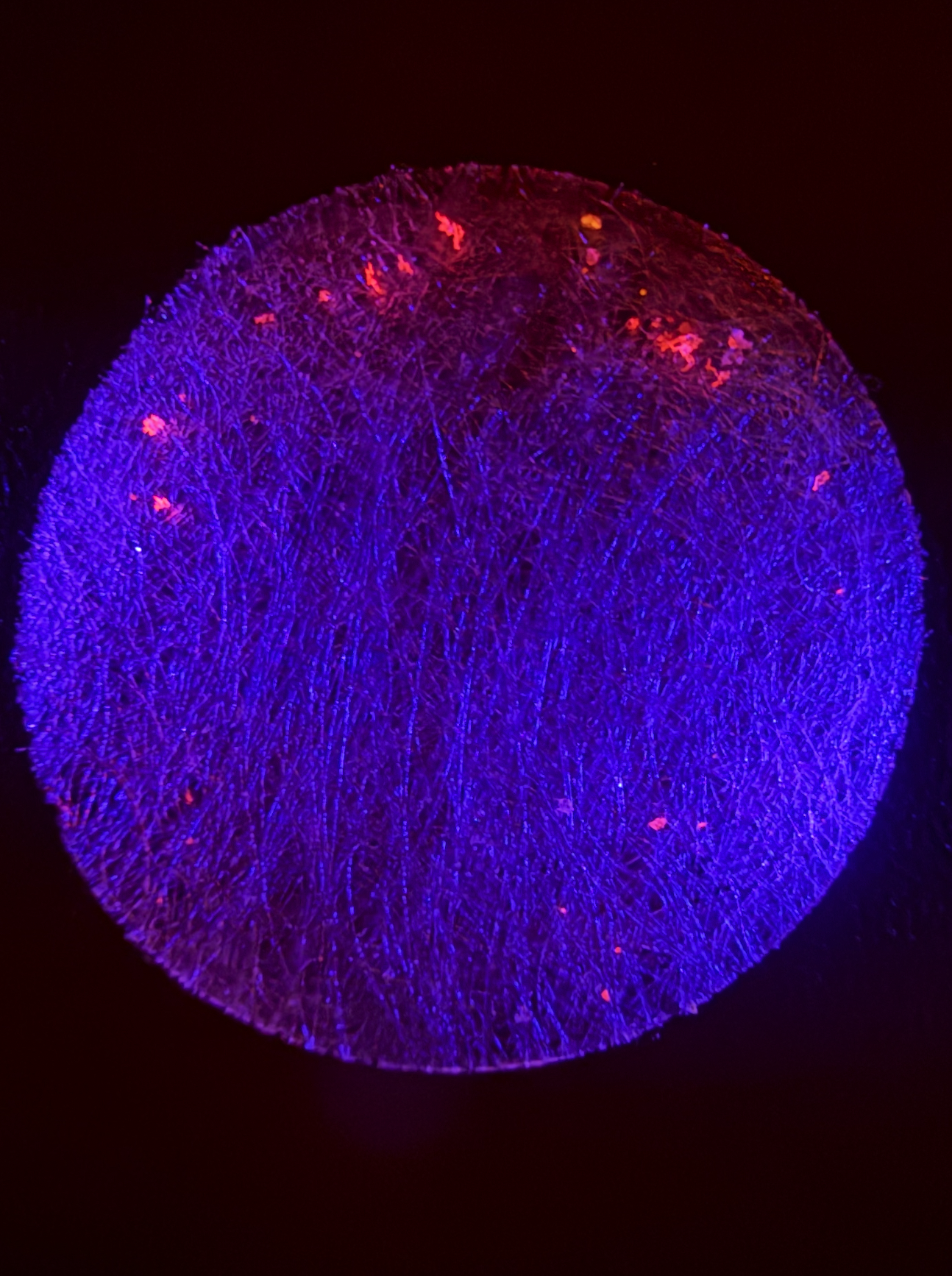
Nile Red stained particles on the filter disc under the digital microscope. PEX flakes appear as the same bright pink dots, counted as likely microplastics.
Where the detection stops
The filter in the kit has a 1 µm pore, so it captures particles down to about 1 µm; anything smaller, including nanoplastics, passes through. The included digital microscope sees particles down to about 5 µm, which is the kit's practical detection limit as shipped; a more powerful microscope can see down to the filter's ~1 µm capture size. PEX shedding in published studies skews small. Hot water, chlorinated supply, and older pipe all push the size distribution toward the nanoplastic end.
Two things follow from that. First, a low particle count on a PEX house does not mean the pipe is clean. It means the visible fraction is low. Second, the kit is well-matched for the part of the distribution that matters to most buyers: particles big enough to count, small enough to drink, already in the cup.
A flake from a cracked elbow, a chunk released when a fitting was disturbed, a shred off an old recirculating loop. Those are comfortably inside the detection window.
What makes PEX shed more
Four factors stack:
- Hot water. Radiant heating loops, recirculating hot lines, and the first draw from a hot tap are the highest-shed samples. Heat accelerates oxidation at the pipe wall.
- Chlorine and chloramine. Municipal disinfectants attack the antioxidant package in PEX over time. Homes on chloraminated supply see faster embrittlement than homes on chlorine.
- High pressure. Anything above about 80 psi works the pipe wall harder. Many homes are running higher than that without a pressure-reducing valve.
- Stagnation. Water that sits in a plastic line for hours picks up particles. Published work shows stagnant samples running up to 10x higher in microplastic concentration than freshly flushed samples.
The sample that shows the most
A two-sample comparison is the cleanest demo on a PEX house. Run two tests, like this:
- Sample A: first water out of the hot tap after overnight stagnation. Collect 100 mL before anything runs.
- Sample B: same tap, after running cold for 2 minutes. Collect 100 mL.
Stain both, filter both, read both under the digital microscope. If the house is plumbed in PEX and the hot line has been sitting, Sample A will carry more fluorescent particles than Sample B. The delta is the shedding signal.
What the kit does not tell you
Fluorescence does not forensically identify a particle. A polyethylene flake in your hot water sample could have come from the pipe wall. It could also have come from a PE-capped bottle you poured from last night, or an LDPE seal on the faucet aerator, or packaging residue somewhere upstream. The kit shows that stained particles consistent with plastic are present; it is a screening count, not a lab-confirmed identification, and some organic matter can also fluoresce. Attribution to a specific pipe segment requires FTIR on extracted particles, which is a lab procedure.
For a homeowner asking whether plastic particles are coming out of their tap, consumer-grade evidence is enough. For a plaintiff's expert in a tort case, it is not.
Who should run this test
PEX became standard in new residential construction and remodels starting around 2005. If the house was built or repiped any time after that, the hot water line is probably PEX. Most owners have no idea. Copper visible at the fixtures does not rule out PEX in the wall.
Good candidates for the hot-vs-cold comparison:
- A house that was repiped in the last 15 years
- A radiant floor system that runs PEX loops
- A home with a hot water recirculating pump
- A rental where you do not know what is behind the wall
- A new build in escrow, before you close
Bottom line
The kit detects PEX particles larger than about 5 µm with the included microscope, which covers every flake big enough to see and most of what gets released from a degrading hot line. It cannot separate PEX from other polyethylene, and it cannot resolve the nanoplastic fraction. What it can do is give you a direct side-by-side of what comes out of your hot tap versus your cold tap, on a Saturday morning, with an at-home kit. Run the hot sample first. Full method writeup.
Related