FAQ
Questions & Answers
Everything you need to know before you order. Want the deep dive on our method? Read how it works, or read up on nanoplastics — the sub-micron fraction a home kit can't see.
About the Test
What's the difference between a kit and a test?
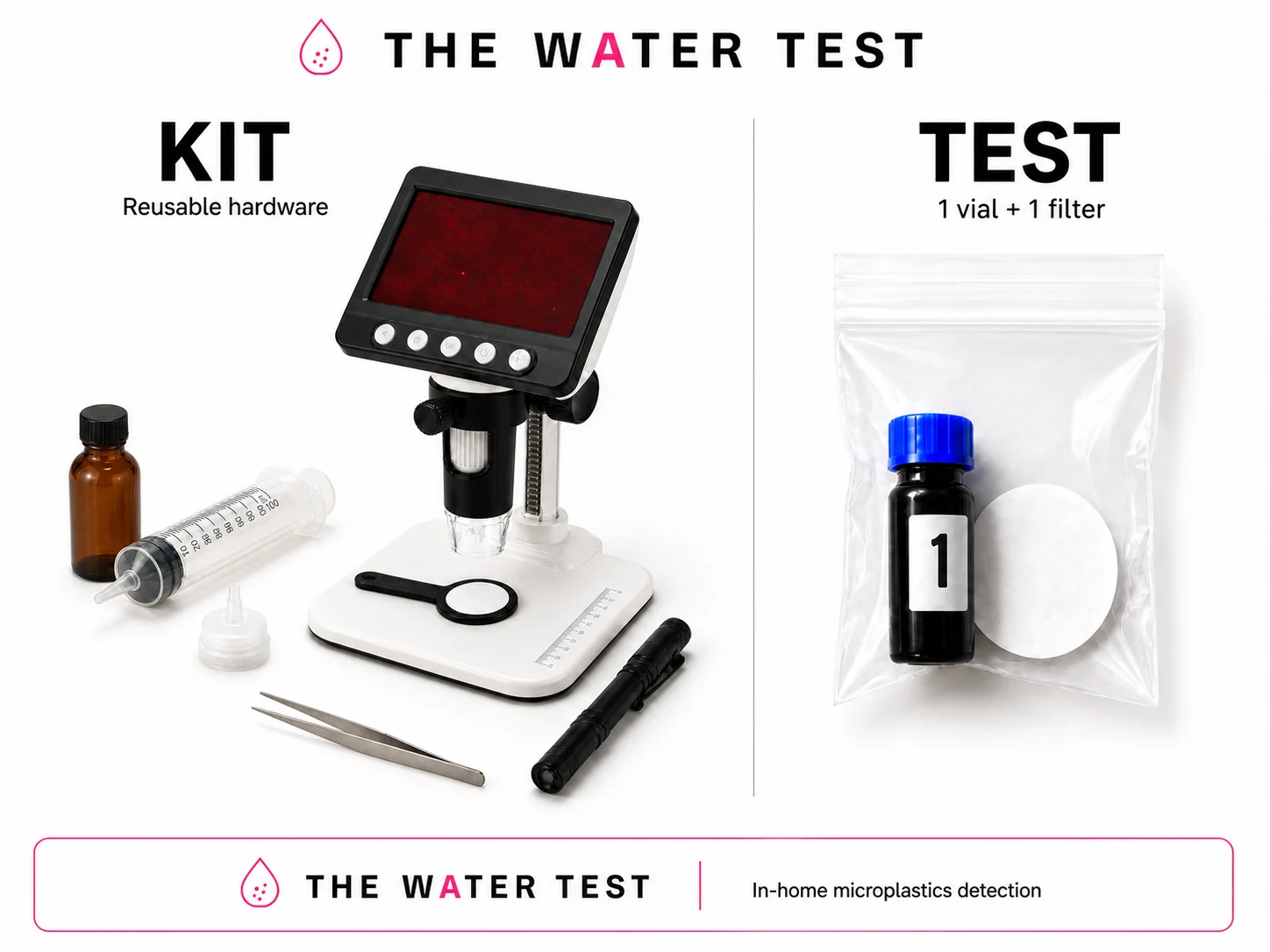
The kit is the reusable equipment — tabletop digital microscope, syringe, membrane filter holder, wand, flashlight, and tweezers. You buy it once and it comes with zero tests. A test is the pair of consumables one sample uses up: one staining vial and one filter membrane. One sample = one test, so order one refill for every sample you want to run.
What does the test actually measure?
You count and size likely microplastic particles in your tap water using Nile Red fluorescence — a peer-reviewed lab method published in the Journal of Hazardous Materials Letters (2022). Particles that take up the stain show up as bright pink dots on your filter under the included digital microscope, and you read the result yourself, in minutes. The filter captures particles down to 1 µm; the included microscope sees particles down to about 5 µm. Some non-plastic material (e.g. certain organic matter) can also fluoresce, so the count is a screening estimate, not a lab-confirmed identification.
How is this different from an $800 lab test?
The expensive tests use instruments that cost $200K+ to identify the exact type of plastic (polyethylene vs polypropylene, etc.). Our test tells you how many particles are in your water and how big they are — which is what matters if you're deciding whether to get a filter. A screening count at a fraction of the price.
How do I get current pricing?
No lab. No shipping samples back and forth. No middleman. You run the test yourself in the home using the same peer-reviewed Nile Red fluorescence method used in research labs. We just packaged it into a kit anyone can use.
Is this hard to do?
Not at all. If you can fill a glass with water and follow simple instructions, you can do this. The kit comes with the tabletop digital microscope, syringe, membrane filter holder, wand, flashlight, and tweezers, plus clear step-by-step directions. Just use any glass container you have at home. Tests — the staining vial and filter membrane you use up on each sample — are sold separately, so order one per sample you want to run.
What about contamination?
Contamination is the biggest source of error in any microplastic test — including lab tests. The kit itself isn't the issue: glass vials, plastic-free sample contact. Your environment is the real variable — airborne fibers settle into open containers. That's why the instructions have you keep the jar covered while you wait. The complete, unvarnished list of error sources is at thewatertest.com/limitations.
Can dust or airborne particles mess up my results?
They can — much of indoor dust is synthetic textile fiber, which stains exactly like the microplastics in your water (minerals and salts don't stain; Nile Red binds preferentially to hydrophobic surfaces like plastic). The protocol minimizes it: keep the container covered while you wait, filter promptly. And running two samples side-by-side cancels most of what remains — ambient contamination hits both roughly equally, so the difference between them is the reliable signal.
What about false positives?
They happen — Nile Red is a screening stain, not a definitive plastic ID. Some non-plastic hydrophobic material (lipids, waxes, rubber, organic matter) can also glow. The standard lab control is a hydrogen peroxide digestion step that removes most of it, but the current kit does not include it because digestion-strength peroxide is a hazardous material to ship — so on organic-rich water, treat the count as an upper bound. Also: black plastics (tire wear, black packaging) often don't take up the dye and can appear dark rather than glowing, and sand or sediment shows up as non-glowing, 3D-textured grains that aren't counted. The method is peer-reviewed (Leonard et al., 2022), but the kit itself has not been independently validated by an accredited lab, and we don't yet have a published kit-specific false-positive rate — the spike-recovery study on the methodology page is what produces one. Every limitation, stated in full: thewatertest.com/limitations.
What can't the test detect?
Nanoplastics — particles smaller than 1 micron — and certain hydrophilic plastics. The filter captures particles down to 1 µm, and the included digital microscope sees particles down to about 5 µm — the kit's practical detection limit as shipped (a more powerful microscope can see down to the filter's ~1 µm capture size). Below 1 µm, detection needs a lab (electron microscopy, stimulated Raman scattering, or py-GC/MS), not a home kit. No consumer test detects nanoplastics. They still matter: nanoplastics are the fraction small enough to cross into blood, brain, and placenta, and a Columbia 2024 study found bottled water held ~240,000 particles per liter, roughly 90% of them nano. Your microplastic count is the visible proxy for that larger invisible load.
I'm not seeing any glowing particles — what's wrong?
The #1 cause is a weak battery in the light source (the flashlight, or the digital microscope's built-in light). A partially drained battery still turns the light on and looks fine, but the output can be too dim to excite the Nile Red stain enough to see it — even though your sample worked. If a test that used to show particles suddenly shows none, swap in fresh batteries before troubleshooting anything else.
Understanding Your Results
Is one test enough?
A single test is a snapshot of your water on that day. It's a strong starting point — especially if your count is high. For a more complete picture, two tests about 30 days apart gives you a reliable baseline. If you're installing a filter, testing before and after is the move.
Why might my neighbor get a different result than me?
Even on the same municipal supply, results vary house to house. Pipe age, plumbing material (plastic pipes leech particles), whether you have a whole-home system, and even time of day all affect your count. That's actually the whole point — municipal averages don't tell you what's coming out of YOUR faucet.
What does my particle count tier mean?
Each sample is placed in a tier based on particle count and size distribution relative to other tests we've processed. A higher tier means your sample had more or larger particles than the average sample in our dataset — nothing more. The tiers are descriptive, not diagnostic, and are not health thresholds.
Is The Water Map based on one test per location?
Right now, each pin represents an individual test result. As we collect more data, we'll layer in averages and confidence levels per area. Think of early pins as: "Here's what one household found." The map gets smarter with every test.
Should I test again after installing a filter?
Absolutely — that's one of the most valuable things you can do. A before/after comparison shows you what your filter is (and isn't) catching. Some filters that claim to remove microplastics don't perform as advertised.
About Us
What's the mission here?
Empowering people to test their own water is the point. Current kit, test, and shipping prices appear on the order page.
Why is this an interesting thing to test?
Microplastics have been documented across the environment and in a wide range of human tissues in peer-reviewed studies (e.g. New England Journal of Medicine, 2024; Science Advances, 2025). Research into what this means for human health is ongoing. We don't make health claims and this kit is not a diagnostic device — we just give you a count of plastic-like particles caught on your filter so you can see what's in your water.
Is there a government standard for microplastics in water?
Not yet. The EPA has no enforceable limits. But California passed SB 1422, which requires major utilities to start testing treated tap water by Fall 2026. New Jersey, Virginia, and Illinois have passed similar laws. Regulation is coming — we let you get ahead of it.
Are you affiliated with any universities or research institutions?
No. Our protocol is adapted from a peer-reviewed paper (Leonard et al., Journal of Hazardous Materials Letters, 2022) — we cite that paper because that's where the method comes from. The authors and their institution have not endorsed, reviewed, or validated this kit. We'd love to run an independent split-sample comparison against an ELAP-accredited FTIR/Raman lab and publish the chart, but we haven't lined up a partner lab yet.
What do you do with my data?
Your individual results are private. Anonymized, location-level data feeds The Water Map — a free public tool showing microplastic contamination by neighborhood. The more people test, the more useful the map becomes for everyone.