Brand Test · September 8, 2026
Which Bottled Water Has the Least Microplastics?
Path had the lowest recorded reading in our seven-brand screening. It still tested positive for particles consistent with microplastics. We did not find a microplastic-free bottled water among Path, Dasani, Liquid Death, Fiji, Evian, Crystal Geyser, and San Pellegrino.
Direct answer
Path returned the lowest numeric fluorescence reading at 106. Dasani returned the highest at 143, and Liquid Death returned 141. The other four brands tested positive but were not assigned individual numbers, so the data supports a lowest recorded result. It does not support a complete ranking from first through seventh.
The seven bottled-water results
We bought all seven brands at retail in Los Angeles and screened them using Nile Red fluorescence microscopy. Every sample returned a PET-like signature from particles consistent with microplastics.
| Brand | Container | Result | What we can say |
|---|---|---|---|
| Path | Aluminum bottle | 106 | Lowest recorded reading |
| Liquid Death | Aluminum can | 141 | Second-highest recorded reading |
| Dasani | Plastic bottle | 143 | Highest recorded reading |
| Crystal Geyser | Plastic bottle | Positive | Not assigned a numeric reading |
| Fiji | Plastic bottle | Positive | Not assigned a numeric reading |
| Evian | Plastic bottle | Positive | Not assigned a numeric reading |
| San Pellegrino | Glass bottle | Positive | Not assigned a numeric reading |
The numeric result is fluorescence signal strength. It does not represent a particle count or convert into particles per liter. “Positive” means the sample returned the same PET-like signature without receiving an individual numeric score in this round.
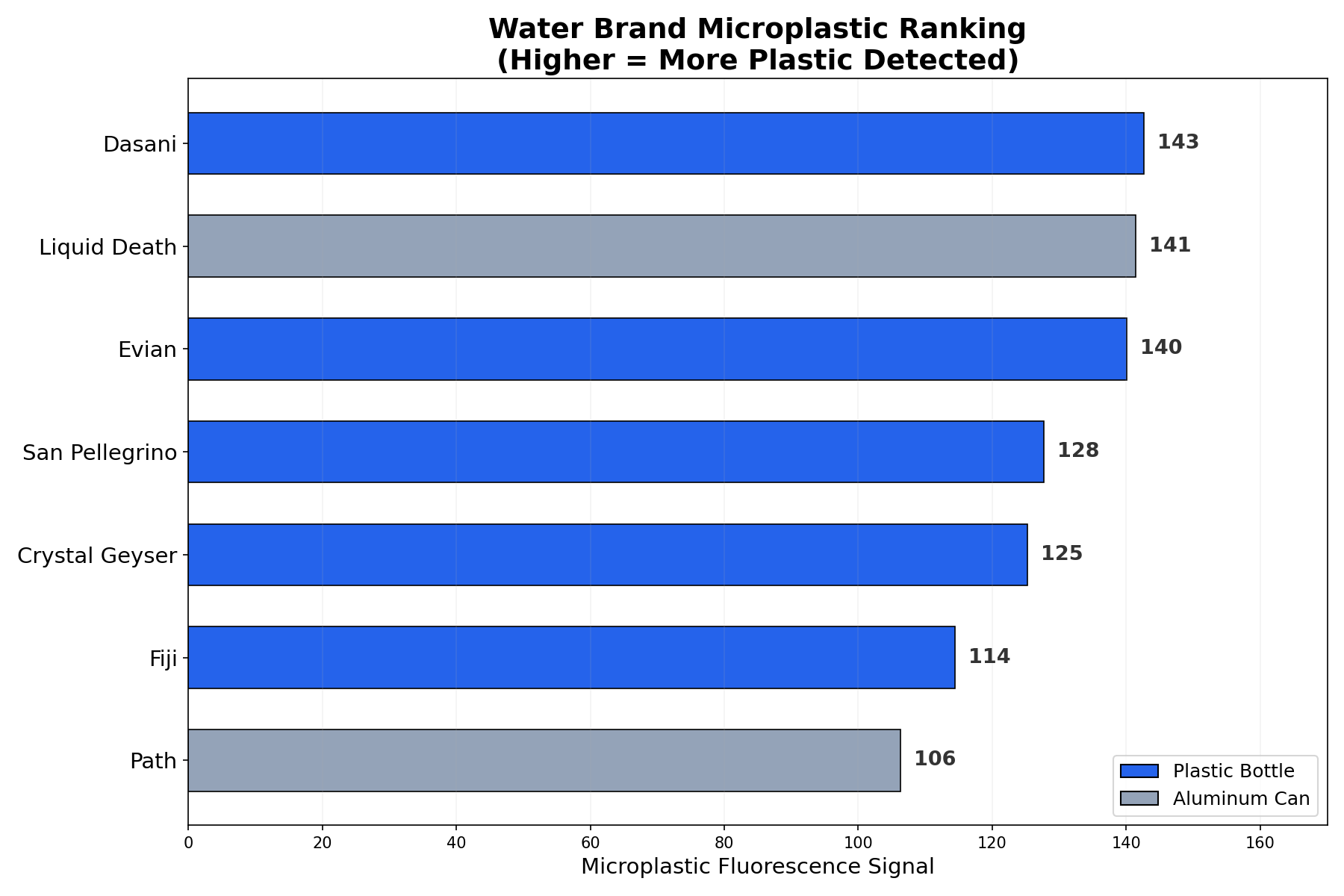
Round 1 of our bottled-water screening. The four positive, unscored brands cannot be ordered against one another from this data.
Is Path the best bottled water without microplastics?
Path was the lowest result we recorded, but it was not free of the signal we were looking for. Calling it “bottled water without microplastics” would go beyond the test result.
This was one screening round on bottles bought in one city. Different production lots, storage temperatures, time on the shelf, and handling can change what ends up in a particular bottle. The result tells you what happened in the samples we tested. It does not certify every bottle sold under the same brand.
The container label did not predict the result
The two aluminum products landed near opposite ends of the numeric results: Path at 106 and Liquid Death at 141. Liquid Death was only two points below Dasani, the highest recorded result. Both aluminum containers have an internal polymer coating that keeps the liquid from contacting bare metal.
San Pellegrino's glass bottle also returned a PET-like signature. Glass itself cannot explain that signal. Possible sources include the cap, the bottling process, or background introduced during testing. We cannot separate those possibilities from one sample.
What “least” means in this comparison
The useful answer is narrow: Path had the lowest recorded fluorescence reading in this round. We cannot turn that into a general claim that Path always has fewer microplastics than every other bottled-water brand.
We also cannot name a bottled-water brand with zero microplastics. If that is the decision you are trying to make at the store, the available evidence does not support a zero-microplastic label for any of the seven products we tested.
See the complete seven-brand bottled-water study for the experimental setup and full discussion of the results.
Test the bottle you actually drink
Brand averages cannot tell you what is in the bottle in your kitchen. Storage and handling differ from bottle to bottle. Our bottled-water microplastics test kit lets you screen a 100 mL sample yourself using Nile Red staining, membrane filtration, and a digital microscope.
Frequently asked
Which bottled water has the least microplastics?
Of the seven brands we screened, Path had the lowest recorded fluorescence reading at 106. Dasani was highest at 143 and Liquid Death was next at 141. All seven brands still tested positive for particles consistent with microplastics, so Path was the lowest in this test but was not microplastic-free.
Is there bottled water without microplastics?
We cannot name one. Every brand in our seven-brand screening tested positive for particles consistent with microplastics. Published research has also found plastic particles across many bottled-water brands, but no study can prove that every bottle from a brand has the same result.
What bottled water had the most microplastics?
Dasani had the highest fluorescence reading in our screening at 143. Liquid Death followed at 141. These are signal-strength readings from a screening process; they do not represent particle counts.
Does aluminum canned water have fewer microplastics?
Our results did not show a consistent advantage. Path, in an aluminum bottle, had the lowest recorded reading, while Liquid Death, in an aluminum can, had the second-highest. Both returned a PET-like fluorescence signature.
Is glass bottled water free of microplastics?
Not in our screening. The San Pellegrino sample from a glass bottle tested positive for a PET-like signature. A single screening cannot identify whether that signal came from the cap, bottling process, laboratory background, or another source.
Related