Filter Review · April 17, 2026
Does the ZeroWater filter remove microplastics?
ZeroWater markets its 5-stage filter as the most aggressive pitcher on the market. It is — against dissolved solids. A ZeroWater pitcher will drop the TDS (total dissolved solids) reading on the included meter to essentially zero, which is why it's called ZeroWater. But microplastics aren't dissolved solids. They're suspended particles. That's a different filtration problem.
What the 5 stages actually do
- Stage 1: Coarse filter screen. Physical sediment block.
- Stage 2: Foam distributor. Even flow across the filter.
- Stage 3: Multi-layer activated carbon. Chlorine, taste, some organic contaminants.
- Stage 4: Dual ion-exchange resin bed. The big one — strips dissolved solids (calcium, magnesium, some lead, chromium) via ion exchange.
- Stage 5: Non-woven membrane + ultra-fine screen. Final particulate cleanup.
Stage 5 is what could physically trap microplastics. ZeroWater doesn't publish a pore size rating for it, and no independent NSF certification for microplastic removal exists on ZeroWater pitchers as of 2026.
What ZeroWater is NSF certified for
NSF 42 (chlorine taste/odor), NSF 53 (lead, chromium, PFOA/PFOS), and NSF 372 (low-lead materials). Not NSF 401 and not any microplastic-specific standard. The company's website mentions microplastic reduction but without a referenced NSF certification line.
The realistic expectation
A ZeroWater pitcher is probably better than a Brita at microplastic capture because of the denser resin bed and finer final screen. But “probably better than a Brita” is not “as good as RO.” A reverse osmosis membrane has a pore size around 0.0001 µm. No pitcher filter gets remotely close to that. See the full comparison across every filter type.
If microplastics are your specific concern, RO is the right investment. If you're on a budget and want to reduce TDS and chlorine and probably some microplastics at a pitcher price, a ZeroWater will do more than a Brita.
Test your own pitcher
Stop guessing, run the test. The microplastic test kit for filtered water uses separately sold tests. Run one on tap, one on ZeroWater output. The filter discs next to each other will show you roughly how much particle reduction you're getting. If you're weighing this against other options, see our roundup of the best microplastic test kits.
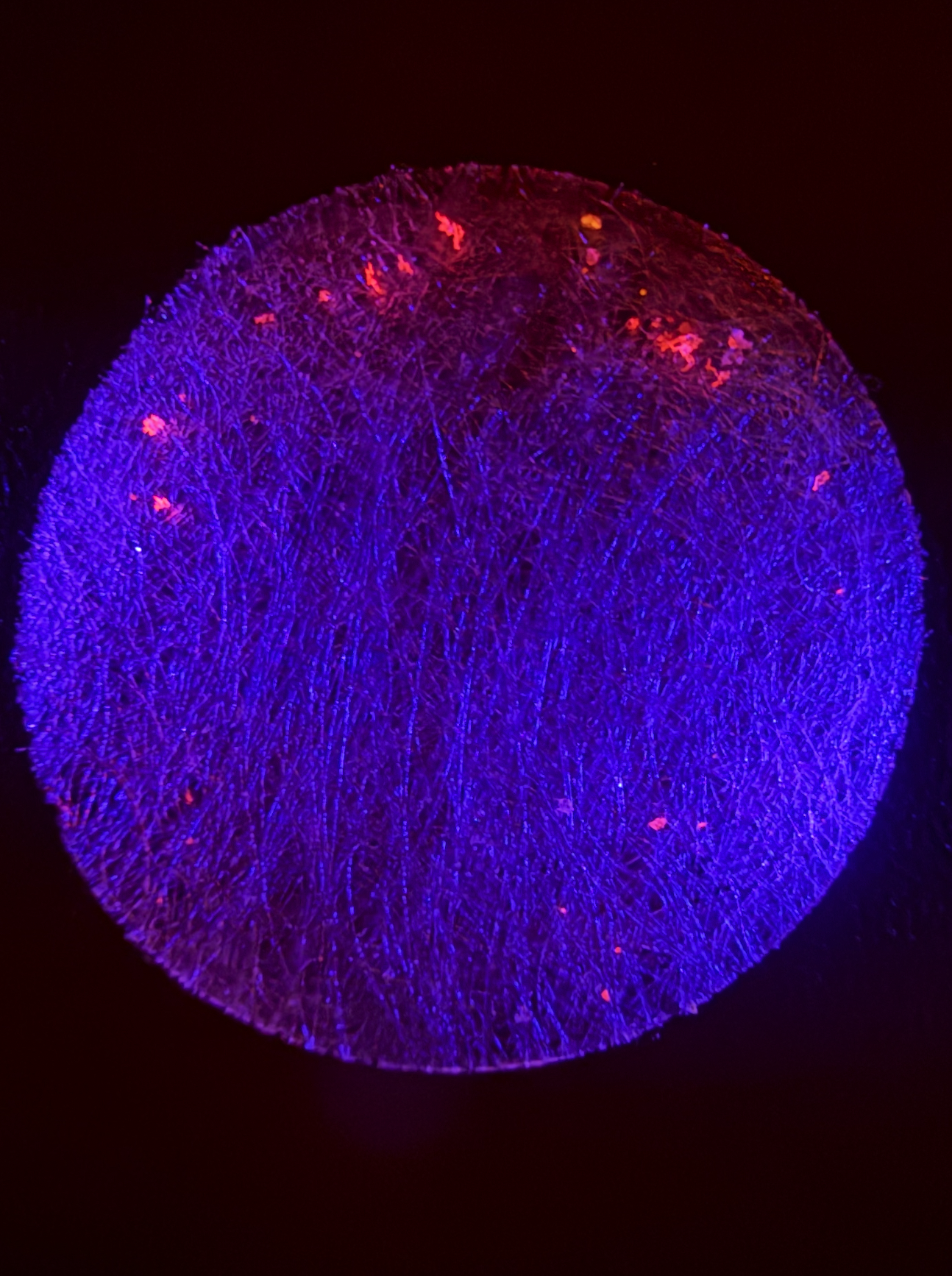
An in-home filter test result. Pink dots mark stained particles — likely microplastics the filter missed.
Common questions about ZeroWater and microplastics
Does the ZeroWater filter remove microplastics?
Not in any certified sense. ZeroWater's NSF certifications (NSF 42, 53, and 372) cover chlorine taste, lead, chromium, and PFOA/PFOS — there is no NSF certification for microplastic removal on ZeroWater pitchers as of 2026. The stage-5 screen can physically trap some particles, but ZeroWater doesn't publish a pore size for it and no third-party testing verifies reliable removal.
Does ZeroWater filter out microplastics better than a Brita?
Probably, because of the denser dual ion-exchange resin bed and the finer final screen. But "probably better than a Brita" is not a certification, and neither pitcher comes close to a reverse osmosis membrane's ~0.0001 µm pore size. If microplastics are your specific concern, RO is the right investment.
Does ZeroWater's 000 TDS reading mean the water is free of microplastics?
No. The included meter measures total dissolved solids — ions like calcium and magnesium that conduct electricity in solution. Microplastics are suspended particles, not dissolved solids, so they don't register on a TDS meter at all. A reading of zero says nothing about plastic particles.
What is ZeroWater certified to remove?
NSF 42 (chlorine taste and odor), NSF 53 (lead, chromium, PFOA/PFOS), and NSF 372 (low-lead materials). Not NSF 401, and not any microplastic-specific standard.
What water filter actually removes microplastics?
Reverse osmosis (pore size around 0.0001 µm) and ultrafiltration (around 0.01 µm) are the consistent removers. Pitcher filters — ZeroWater included — are inconsistent and uncertified for this.
How can I tell if my ZeroWater is removing microplastics?
Run a before/after test. Fill one 100 mL sample from the cold tap and a second from the ZeroWater spout, run both through an in-home microplastics kit, and compare the two filter discs side by side. That's the only way to see what your specific pitcher is catching.
Related